- This event has passed.
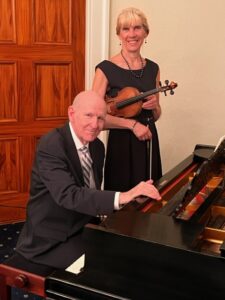
Cummings / Owens: Violin & Piano Duo
Program Highlights:
Sonata in B-flat, K. 378 . . . . . . . . . . . . . . . . . . . . . . . . . . . . . W.A. Mozart (1756-1792)
Allegro moderato
Andantino sostenuto e cantabile
Allegro
Sonata in A (1919) . . . . . . . . . . . . . . . . . . . . . . . . . . . . . Ildebrando Pizzetti (1880-1968)
Tempestoso
Preghiera per gli’Innocenti (Molto Largo)
Vivo e fresco
Sonata No. 1 in G Major, Op. 78 . . . . . . . . . . . . . . . . . . Johannes Brahms (1833-1897)
Vivace ma non troppo
Adagio
Allegro molto moderato
The Composers:
Wolfgang Amadeus Mozart completed this B-flat Major sonata in Salzburg in 1779, just prior to his settling in Vienna. Soon after his move he became involved in having several of his works published, including this and five other sonatas for violin and piano, dedicating the lot to one of his most gifted piano students, a Josepha Barbara Aurnhammer. The six have been known, in the Mozart canon, as the ‘Aurnhammer Sonatas’. The piano parts of his pieces, whether he played them at house recitals or in subscription concerts, often survived as mere sketches of what the master improviser proposed to realize in performance, and it is widely supposed that Fräulein Aurnhammer played a major part in filling out these piano parts for first editions. One charming touch in this ingratiating work, is the third movement’s reprise of a descending phrase heard near the end of the second movement.
Ildebrando Pizzetti was among the relatively few Italian musical artists whose careers were not upended by the Great War. Along with everyone else who lived through it, however, he was terribly shaken by it. His Sonata in La per Pianoforte e Violino was written as a response to the horrors of war, although the bulk of the tragic emotion resides in the extensive first movement. The second is a touching, poignant Preghiera per gli’Innocenti – A Prayer for the Innocent – referring of course to the countless children whom war brutalizes.
A deeply religious current runs throughout most of Pizzetti’s work, and the first and third movements present various treatments of a chantlike lyrical theme. Happy spirits set in with the finale, which rises to undeniable heights of life-affirming hope.
The bulk of Pizzetti’s output lies in his thirteen operas, many of which seem inspired dramatically by the tradition of the Medieval mystery plays. As a music administrator, he succeeded Respighi as composition professor at the Santa Cecilia Academy in Rome, serving as its director from 1948 to 1951.
Johannes Brahms wrote his G-Major violin/piano sonata during the summer of 1879, in a favorite holiday spot in southern Austria. The work itself is winningly sunny, and it has been said that many listeners who perhaps find Brahms’s music serious and foreboding tend to be won over by this sonata’s friendliness. Its songfulness owes much to the fact that the third movement amounts to a fleshed-out study of his song, Regenlied (Rain Song), Op. 59, no. 2, which is taken in this movement to lengths well beyond the haunting parameters of that exquisite song. But midpoint in this movement, Brahms is again at pains to let us know he is not done with, in this case, the second movement’s lovely main theme, which he calls up for further treatment. This motif combines with the ‘rain song’ music to add still more loveliness and lustre – showcasing Brahms’s considerable talent for recycling and redeveloping his own material.
The Performers:
Cynthia Cummings studied at the University of Michigan with Paul Makanowitzky, at the University of Southern California with Eudice Shapiro, and earlier with Burton Kaplan and Charles Castleman.
Associate Concertmaster of the Omaha Symphony for three years, Cynthia was also a Tanglewood Fellow for three summers. She served with the Thayer Symphony Orchestra in South Lancaster, MA, both as concertmaster and soloist. She was a founding member of the Arriaga Quartet, and has played with the Boston Pops Esplanade Orchestra since 1987, as well as with other ensembles in and around Boston. Her violin is a 1752 creation of the Spanish luthier Joseph Contreras.
David Owens began his long experience as a collaborative pianist while he was majoring in composition at the Eastman School of Music, in Rochester. His passion for chamber music was formed there and has never ebbed. David worked at Eastman with Brooks Smith (Heifetz’s longtime accompanist), and later in New York City with chamber-music giant Artur Balsam. He has produced a sizeable number of compositions – orchestral, choral and chamber – including a series of Soliloquies for a variety of solo instruments.